
Hamilton Projected Versus Actual Release
Hamilton County’s current HCSO detail can display Projected Release Date, but the field may also read NA. It belongs to a current-custody record. It does not certify that the person later walked out of the Justice Center. A holder, second case, bond condition, transfer order, or corrected sentence can prevent the expected community departure. Read the Holder field and every charge row before using the date.
ODRC uses the exact label Expected Release Date/Parole Eligibility Date. Its glossary defines the field as a projected release date or a date pending parole consideration. The slash is important. For one person, it may be a definite-term expected date. For another, it may mark eligibility for a board decision. Neither is an unconditional appointment.
A person awaiting trial has no sentence-expiration date. Bond and court orders may create a path out, but release processing and other holds still control. A sentenced person has a computation, though the result can change under the lawful rules that govern the sentence.
Find Hamilton County Projected Release Dates
Start with the agency that holds the person. HCSO covers the county Justice Center. ODRC covers Ohio state prisons and APA supervision. A court docket explains the legal sentence and jail-time credit, but it may not record the moment of physical departure. Federal and immigration custody require separate systems. The Hamilton County released-inmate search maps those custody paths when the responsible agency is unclear.
- Search the HCSO current inmate page by first and last name. If a result appears, record the inmate and booking numbers, projected date, holder flag, and all case numbers.
- Open each Hamilton County court case. Read the judgment, effective sentence, concurrent or consecutive structure, jail-credit entry, bond changes, and later corrections.
- If the sentence sent the person to Ohio prison, use the ODRC Offender Search. Match the offender number and Hamilton committing county.
- On the detail, read status first. Then compare aggregate or net sentence, mandatory terms, jail credit, parole data, and
Expected Release Date/Parole Eligibility Date. - For a disputed county computation, call HCSO Jail Records at 513-946-6309 or request the existing computation and final movement record. For a certified state calculation, write ODRC Central Records.
The HCSO detail layout shows where Hamilton County places its projected date beside holder, bond, case, and disposition data.
The surrounding fields explain why the displayed date cannot stand alone. A completed sentence on one charge does not overcome another case or holder.
Ohio Credit in Hamilton Release Dates
Ohio has no universal rule that every prisoner serves 85 percent of a term. For confinement on and after April 4, 2024, ORC 2967.194 permits an eligible person provisionally to earn one or five days for each completed month of productive participation, based on the statutory category. Ordinary aggregate participation and completion credit is capped at 15 percent of the stated term. The 85-percent shorthand works only as a rough illustration for an otherwise eligible definite component that earns the full cap.
Many facts break that shortcut. Mandatory and non-reducible terms remain. Exclusions cover death, murder and aggravated murder terms, life without parole, specified sexual-offense sentences, and other terms named by law. Separate successful program completions may support a 90-day or 10-percent reduction, whichever is less, when the statutory criteria are met. Credit can be withheld or withdrawn. Earlier confinement is governed by the prior statute, ORC 2967.193, and older sentence-era rules.
ORC 2967.191 separately governs jail-time credit certified through the judgment. Start with the effective sentence and its concurrent or consecutive structure. Subtract certified jail credit. Apply only credit awarded under the law for the relevant time. Preserve mandatory terms, then distinguish a definite expiration from parole eligibility. ODRC maintains the official state calculation.
Note: Jail-time credit and earned participation credit arise under different statutes and should not be merged into one assumed percentage.
Why Hamilton Release Dates Change
A projected date changes when the inputs or legal path change. The source should show which event matters. A date moving does not by itself reveal misconduct or a new sentence. Seek the judgment, computation, hearing result, or holder record that supports the change.
| Factor | Effect on the forecast | Best confirming record |
|---|---|---|
| Jail-time credit correction | Changes credited time already served | Later sentencing or jail-credit journal entry |
| Earned credit award or withdrawal | May move a definite-term expectation within statutory limits | ODRC sentence computation |
| Mandatory or non-reducible term | Blocks reduction for that component | Judgment and ODRC sentence detail |
| Holder or detainer | May prevent community departure after one term ends | HCSO holder and final destination record |
| Parole decision | May authorize, continue, or deny a release path | Board minutes, POA/PRD, and later status |
| New or corrected court order | Changes sentence structure or authority | Chronological court docket and journal |
A favorable parole action remains a decision stage. OAC 5120:1-1-10 requires official minutes to state a projected release date after a favorable determination, but processing, placement, review, or new information can intervene. Confirm that the state later records APA supervision or release.
Confirm Hamilton County Actual Release
For the Justice Center, ask HCSO for the booking or release record that states the actual date and time, release type, and destination. If the person vanished from the current roster, absence is not enough. The movement could be a community release, transfer to ODRC, another county, federal custody, or ICE. The final record should preserve that distinction.
For state prison, open the ODRC detail again after the expected date. APA SUPERVISION means release from incarceration under Department supervision. Released supports departure from ODRC custody, but no APA fields means probation should not be invented. An old institution line may remain on a supervised record. Read status first.
Ohio VINE can send a custody event notice, and the Hamilton County VINELink check explains registration. A county general release differs from transfer. A state release-from-parole event marks the end of supervision, not prison exit. The Ohio Attorney General says not to rely on VINE alone, so corroborate the alert with HCSO or ODRC.
Ohio's Combined Release Date Field
ODRC deliberately combines Expected Release Date/Parole Eligibility Date. That wording forces the reader to examine sentence type. A definite sentence can support an expected date after required calculations. An indefinite or parole-eligible sentence can instead show when consideration may occur. Eligibility is not a promise of release.
The ODRC definitions page gives the controlling field and status meanings.
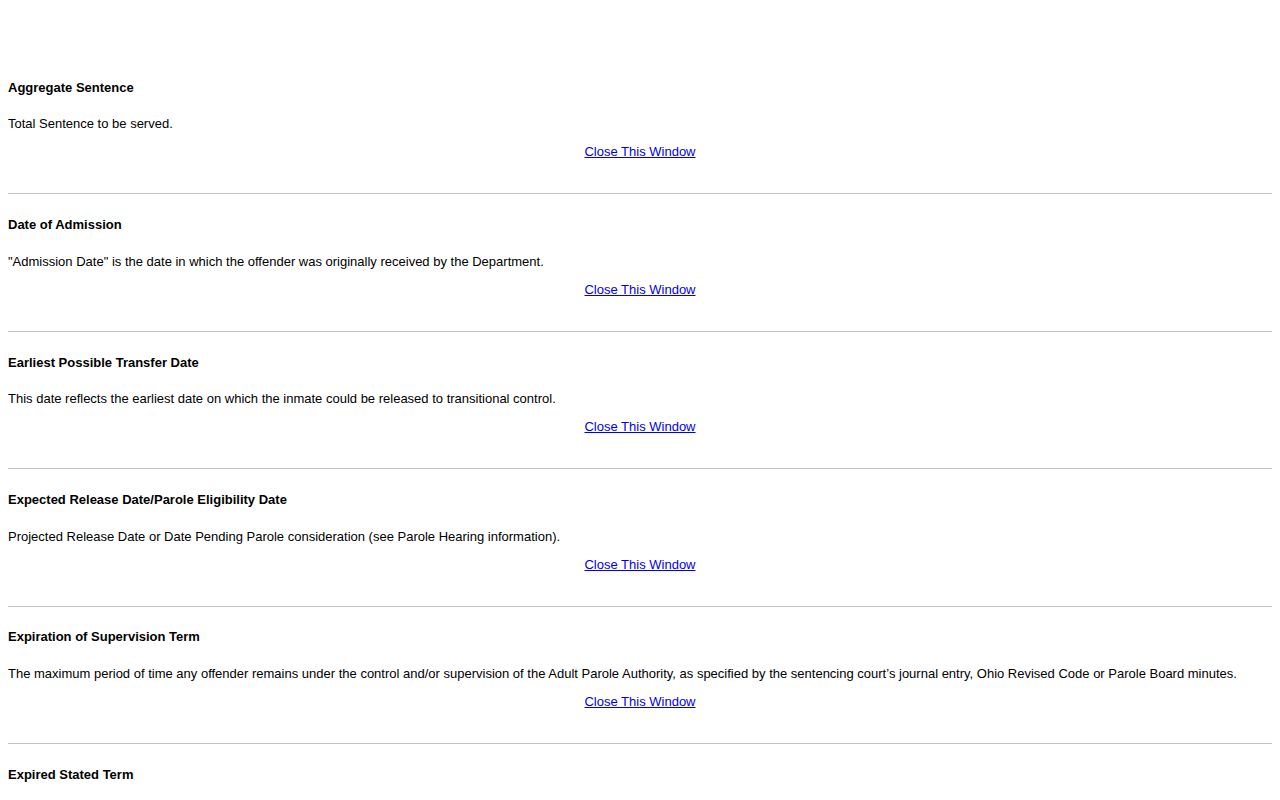
The glossary should be read with aggregate sentence, jail credit, mandatory years, hearing history, and POA/PRD. That complete set explains whether the date is a forecast, eligibility marker, or post-decision projection.
Hamilton Release Dates for Indefinite Terms
For non-life indefinite sentences, ORC 2967.271 creates a rebuttable presumption of release at the minimum term or presumptive earned early-release date. “Rebuttable” means the presumption can be overcome. After a hearing and statutory findings, ODRC may continue confinement, subject to the maximum term.
That hearing process is another reason a displayed expected date can move. It also shows why a date in the past does not prove release when status still reads incarcerated. Check the hearing outcome, later sentence information, and current status. The actual release point comes from the state’s later record, not from a forecast copied before the hearing.
Hamilton County and State Calculations
A Justice Center calculation and an ODRC calculation answer different custody questions. For a county sentence, the Hamilton County judgment supplies the term and court-certified credit. HCSO administers the jail record. When the same judgment commits the person to state prison, disappearance from the county roster reflects transfer, not community release. ODRC then records admission and performs the state computation.
Case structure matters. Concurrent terms run at the same time, while consecutive terms run one after another. A disposition of COMPLETED SENTENCE on one HCSO charge line settles only that component. Another case or holder can keep the person in custody. The current roster result outweighs a single completed line for the immediate custody question, and the final movement record should name the actual destination.
The Hamilton County Clerk docket is central when credit is disputed. Look for the sentencing journal, jail-time-credit order, and later corrected entry. ODRC uses the court-certified total. An informal estimate, an old screenshot, or a date obtained before a correction should not be presented as the official computation. Request the existing calculation from the custodian when the public fields do not reconcile.
Hamilton Parole Dates Have Stages
Parole eligibility means the person may be considered. A hearing result records what the Ohio Parole Board decided at that stage. A favorable result can lead to a POA/PRD, or projected release date, but it still is not proof of departure. Placement, processing, chair review, or new information may intervene before the state changes the custody status.
Read the ODRC detail in sequence: current status, next or latest hearing month, latest hearing type and result, POA/PRD, and supervision start. An old hearing month may remain as history and should not be called an upcoming event. A transitional-control denial concerns that pathway only and does not by itself set the sentence expiration or rule out every later lawful release route.
After the projected date, seek a state result marked APA SUPERVISION or Released. APA supervision confirms release from incarceration under Department supervision. A release result without supervision fields should not be relabeled probation. County community control comes from the Hamilton County court and remains a separate record path.
Request Hamilton Release Computation Records
When an online date is not enough, request the narrow record that answers the issue. For HCSO, identify the name, booking number, and custody episode, then ask for the sentence computation and final movement record. For ODRC, give the full offender number and distinguish the sentence-computation record from a release or discharge record, parole-board minutes, and supervision start or termination record.
ODRC Central Records receives mail at P.O. Box 430, Columbus, OH 43216. A focused request reduces delay and avoids protected parts of a broad institutional file. If the question concerns jail-time credit, include the Hamilton County case number and locate the certified court entry first. If an office says a request is too broad, ask how the calculation record is organized and revise the wording to match the maintained record.
Public Record Search
Sponsored Results