
Federal Custody Release Paths
Federal custody is a system, not a Hamilton County facility. No federal prison was identified in the county material as a substitute for the Justice Center. A person can appear at HCSO on a federal holder, under a writ, or in a pretrial arrangement. When HCSO closes that booking for USMS pickup, county custody ended while federal custody continued. The HCSO movement record and federal docket should be read as consecutive events.
A sentenced federal prisoner is normally searched through the Bureau of Prisons. A public result can show the register number, age, race, sex, release date, and a facility or status phrase. Federal pretrial detention is different. USMS is responsible for many pretrial movements, and there is no public former-detainee release locator comparable to BOP. The Southern District criminal docket may show detention, bond, judgment, sentence, and supervised-release terms.
Release from BOP also has a narrow meaning. A past release date with no facility supports that BOP custody ended on that date. It does not rule out state custody, immigration custody, another jurisdiction, or a federal supervised-release term. State each source's limit rather than broadening “not in BOP custody” into a claim about all custody.
Search Federal Release Records
Use the BOP Inmate Locator for a sentenced federal prisoner. Search by register, DCDC, FBI, or INS number when one is known. A name search can be refined by age, race, and sex. Compare the result with the Hamilton County or Southern District case so a common name is not mistaken for the intended person.
- Search the strongest known federal identifier first.
- If using a name, apply only supported demographic refinements.
- Match the register number and case details.
- Read both the release-date field and the location or status phrase.
- Treat a future release date as projected.
- Use the federal docket or BOP records for details the locator does not provide.
The public BOP search and released-result layout are shown on the official federal locator captured below.
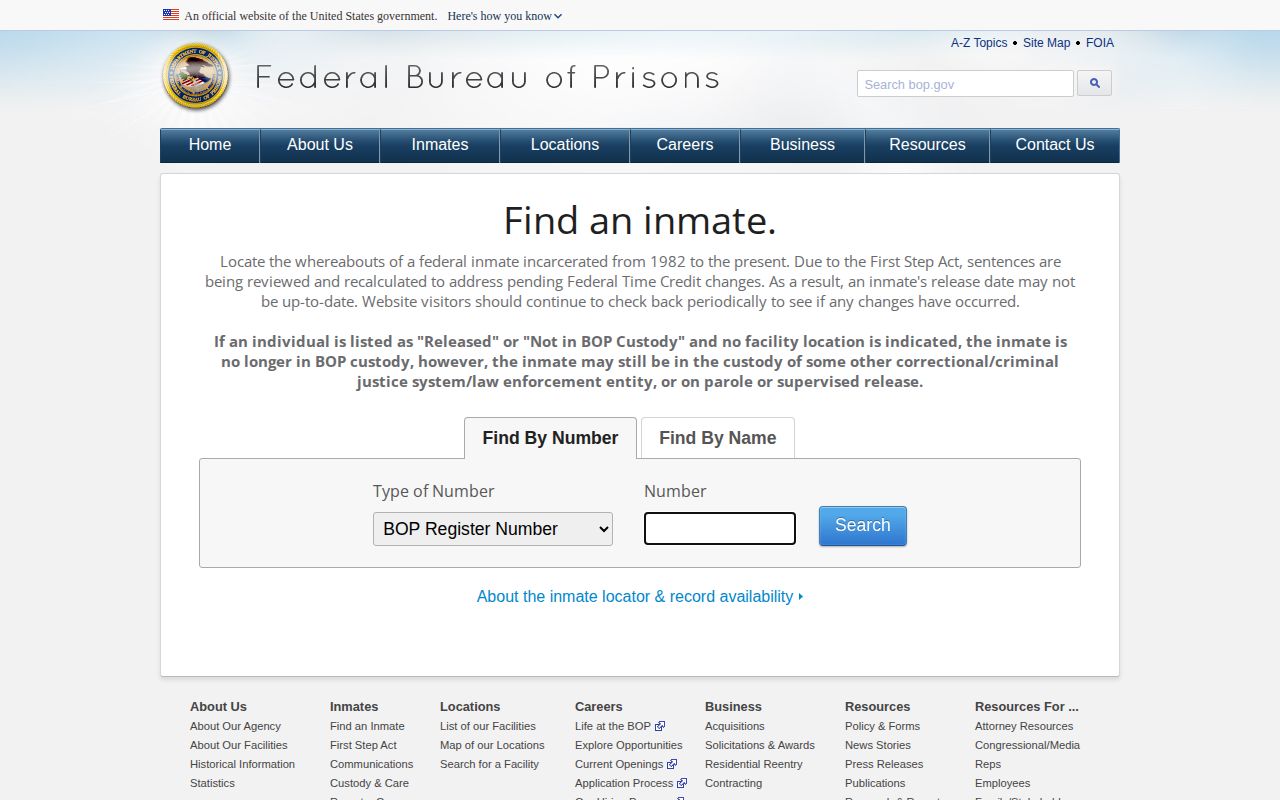
The screenshot documents the federal search route. It does not establish that a person in a Hamilton County case entered BOP or that every later custodian released them.
Federal Release Status Meanings
BOP publishes explanations for its result phrases. Read the release date and location together. A past date plus no facility indicates that BOP reports release on that date. `RELEASED` and `Not in BOP Custody` both concern the end of BOP custody. A future date remains a projection, and a movement phrase can show that custody is still active.
| BOP result | Supported meaning |
|---|---|
| Past release date, no location | BOP reports the person left BOP custody on that date. |
| RELEASED | The person is no longer in BOP custody; another status may remain. |
| Not in BOP Custody | BOP custody is not current, but the locator does not clear other custodians. |
| IN TRANSIT | Federal movement continues; it is not release. |
| Community Corrections Management | The placement can remain BOP-connected and should not be called an unconditional discharge. |
| Future release date | The date is projected and may change. |
BOP's locator principally covers federal prisoners released since 1982. Older records can require another route. Its scope also does not include every USMS pretrial episode. A negative result may mean the person was never a sentenced BOP prisoner, the identifier is wrong, or the record falls outside public coverage.
Location text matters as much as the date. A Community Corrections Management entry can reflect a halfway-house or related BOP placement and should not be treated as a complete federal discharge. `IN TRANSIT` likewise means movement. When a projected date has passed but the status still indicates custody, check for an update, sentence change, or later record rather than backdating a release. The locator's current phrase controls the public reading.
Hamilton Federal Pretrial Custody
A federal pretrial detainee may remain under USMS responsibility in a local or contract bed without ever entering BOP as a sentenced prisoner. The Southern District of Ohio in Cincinnati is the federal court route for Hamilton County cases. Search the criminal docket for the detention order, bond decision, judgment, sentence, and supervised-release terms.
If HCSO showed a federal holder, preserve the holder text, booking number, and case numbers. Then use the federal docket. A blank BOP result at this stage is expected and does not prove release. If the person is later sentenced to BOP, the register number and BOP locator become the stronger custody identifiers.
Southern District of Ohio
Phone: 513-684-3594
District contact, not a public former-detainee database.
PACER is the federal case-access channel when public docket detail is needed. The district clerk can address court records. USMS contact can clarify agency routing, but it should not be represented as a searchable release archive. The Hamilton County release verification path explains how the original HCSO booking and holder fit into the broader chain.
Hamilton-to-Federal Custody Transfer
A release code can close the Hamilton County booking when another custodian takes over. The precise phrase should be “released from Hamilton County custody to USMS” when the record supports it. That does not mean release from federal custody. Check the HCSO record for actual movement time, type, and destination, then confirm the federal case stage.
The Hamilton County court docket is not the right source for a federal detention decision, though a local case can explain why HCSO first held the person. Federal orders belong in the Southern District docket. A BOP admission belongs to BOP. Keeping those records separate prevents a county departure date from being mistaken for the later federal release date.
A person held on a federal writ may also move temporarily between systems. A temporary court appearance does not end the underlying custody. Likewise, BOP `IN TRANSIT` indicates movement rather than release. Report each custodian and date only to the level supported by the record.
Federal Custody Release Records
The locator is a public index, not a complete discharge file. When its result is insufficient, use BOP FOIA for agency records. Identify the person with the register number and request the specific release or custody record rather than an undefined full file. For case orders, use PACER or the Southern District clerk because judicial records and agency records follow different access routes.
- BOP locator record
- Public name, register number, demographic fields, release date, and location or status.
- BOP release record
- Agency documentation sought through the appropriate BOP records process.
- Federal docket
- Court orders for detention, bond, judgment, sentence, and supervised release.
- USMS movement
- Pretrial or transport information that may not produce a sentenced BOP record.
Ask for the narrow document needed and use an exact identifier. A future locator date does not substitute for an actual release record. A past date can establish the BOP endpoint but not the end of supervised release. Federal supervised release is imposed by the court and differs from Ohio APA parole or Hamilton County probation.
For the earlier county movement, request HCSO's booking/release record. That record can show the destination as federal custody. It cannot document when BOP custody later ended. The federal docket and BOP record must supply that part of the chain.
Confirm Federal Custody Departure
Begin with the correct branch. If a BOP register number exists, match the locator to the case and interpret the date with the status phrase. If the person was federal pretrial, search the Southern District docket and do not demand a BOP result that may never exist. If the person left HCSO on a federal holder, preserve both the county movement and the later federal evidence.
| Evidence | What it confirms |
|---|---|
| HCSO transfer to USMS | The Hamilton County booking ended and federal custody continued. |
| Federal detention order | The court ordered the federal pretrial status. |
| BOP admission or facility | The person entered sentenced federal custody. |
| Past BOP release date with no location | BOP custody ended on the reported date. |
| Supervised-release term | Federal court supervision follows custody and is a separate status. |
Negative searches remain weak evidence. Try the federal identifiers and exact name, check the case docket, and account for BOP's historical scope. The final statement should be limited, such as “BOP reports a past release date and no present BOP custody.” Do not expand it to every jurisdiction when another holder, case, or supervision term has not been resolved.
One common Hamilton County sequence begins with an HCSO federal holder, continues through a USMS pretrial episode, and later produces a BOP record only after sentence. The county release date, federal detention order, BOP admission, and BOP release date are four separate facts. A person held only before trial may have the first two without the last two. That absence is a scope issue, not proof of community release.
Another sequence ends BOP custody but begins federal supervised release. The judgment states the supervision term and conditions, while the BOP locator states the prison endpoint. Supervised release is administered through the federal court system and must not be called Ohio parole, APA supervision, or Hamilton County probation. If the exact end of supervision matters, consult the later federal docket entries rather than deriving it from the BOP date.