
Ohio Prison Release Path
Ohio State Correctional Institutions are operated by ODRC and receive sentenced people from counties across the state. They are not Hamilton County jail facilities. When the Justice Center moves a person to an ODRC reception institution, the correct statement is that the person transferred from HCSO to state incarceration. HCSO's booking may close, yet no community release has occurred.
The state record becomes the main public bridge. An ODRC admission date, committing county, docket, sentence, and incarcerated status can confirm that the Hamilton County sentence entered state custody. Later, APA SUPERVISION, Released, or judicial-release information may show that prison custody ended. The sentencing court remains important because its judgment supplies the sentence and certified days already served. ODRC supplies the state custody and supervision record.
Where the person goes depends on the state event. APA SUPERVISION means release from incarceration under department supervision. A Released status without APA fields supports departure from ODRC but should not be described as county probation. Judicial release requires the sentencing court order and compatible ODRC status. A transfer between Ohio prisons is still state custody.
Search Ohio Prison Release Records
The ODRC Offender Search accepts a last name alone or a first and last name. A known offender number is stronger. Male numbers generally use A or R, women use W, and six digits are entered without punctuation. Add a leading zero to a five-digit female number. Search broadly first, then compare Hamilton as the committing county, the docket, offense, admission date, and sentence.
- Search the person's last name, or enter the known ODRC number.
- Use Released, APA Supervision, or Violators at Large only as appropriate filters.
- Match Hamilton County, docket, admission date, and sentence facts.
- Open the detail and read Status before Institution.
- Review release/parole results, POA/PRD, supervision start, period, and APA office.
- Request ODRC records when the exact legal discharge or computation is needed.
A prison name can remain on a record after release. If Status says APA SUPERVISION, the institution line describes the earlier incarceration episode. Incarcerated means the person remains in ODRC custody even if temporarily out for court. Violator At Large means an APA supervisee is reported as having absconded. It is not a present location, and law enforcement must verify any warrant.
The wider Hamilton County released inmate record path helps when the state result must be matched back to the HCSO booking and Hamilton County court case.
Ohio Prison Release Fields
ODRC details contain more than a date. The fields should be read together because one value can describe a past stage while another controls the current interpretation. The search can also lag, and ODRC warns that sentence lists may be incomplete or supervision may relate to another offense.
| Field | How to read it |
|---|---|
| Status | Controls whether the person is incarcerated, under APA supervision, released, judicially released, or listed as a violator. |
| Admission and institution | Describe entry into and placement within the state prison episode. |
| Expected Release Date/Parole Eligibility Date | A projected date or a date pending parole consideration, not an unconditional appointment. |
| Release or parole result | Records a decision or state release stage; compare it with status and later fields. |
| POA/PRD and supervision start | Can corroborate movement from prison into APA supervision. |
| APA office and period | Identify the numbered supervision unit and reported duration after prison. |
ODRC's official definitions are shown on the state offender-search glossary captured below.
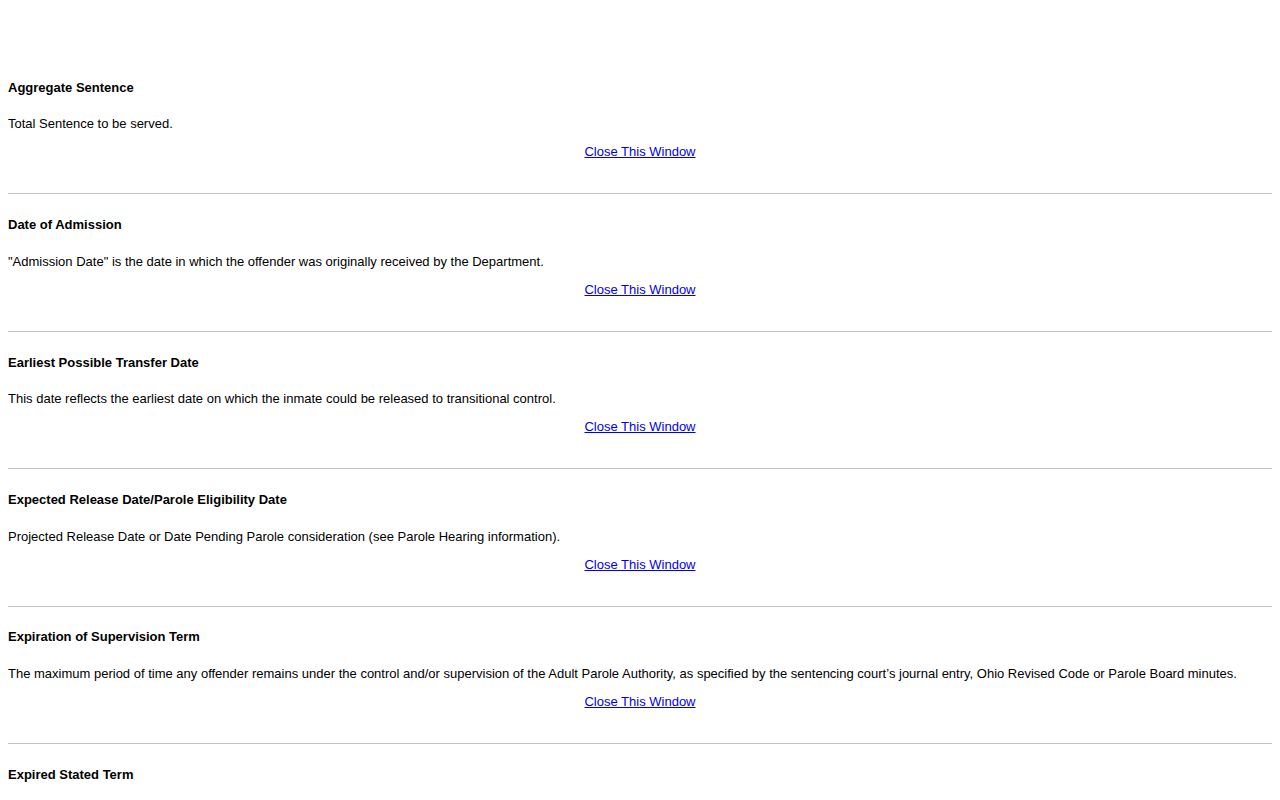
The glossary confirms that the combined date can represent either projected release or parole consideration. It should never be published as proof that physical release happened.
Ohio Expected Release Date
The exact ODRC label is Expected Release Date/Parole Eligibility Date. A definite sentence may produce an expected date, while another sentence may produce the point when the Parole Board can consider release. Eligibility is not approval. A favorable board result can still precede processing, placement, review, or new information, so look for a later status change, POA/PRD, and supervision start.
Read aggregate or net sentence, certified days already served, mandatory terms, sentence type, and hearing results with the date. An expected date in the past does not prove release when Status remains Incarcerated. A future POA/PRD following favorable board action is still prospective. Transitional-control denial concerns that path and does not settle every future release route.
Hamilton County confinement time and the state release calculation are related but not interchangeable. The sentencing judgment supplies the certified days and the concurrent or consecutive structure. ODRC applies that material within the state sentence. When the total is disputed, review the Hamilton County sentencing entry and any later correction before asking ODRC for its computation record. Do not estimate release by counting from arrest dates. Mandatory terms, indefinite sentences, parole eligibility, and awarded sentence reductions can produce a result that differs from a simple calendar calculation.
Ohio also has no universal rule that every person leaves prison after serving 85 percent. Earned-time reductions depend on the governing statute, the confinement period, eligibility, productive participation, mandatory components, and other limits. That issue can change a projection, but the official ODRC calculation and later status still control whether prison custody actually ended.
Ohio APA Release Supervision
The Ohio Adult Parole Authority supervises state parole and post-release control. It is separate from Hamilton County Adult Probation, which is court supervision. ODRC details may show supervision start, period, public conditions, a numbered Cincinnati APA office, and a parole or release result. Those fields support the state transition from incarceration to community supervision.
- Parole
- Discretionary release from an eligible prison term under conditions set through the state process.
- Post-release control
- State supervision that follows specified felony prison terms.
- Judicial release
- Prison release ordered by the sentencing court and reflected in ODRC records.
- Discharge
- The end of the applicable custody or supervision obligation, depending on the record.
- Violator At Large
- An APA absconder status, not proof of present incarceration or a public location.
A record marked Released with no APA fields should not be converted into a claim of probation. If a VAL result appears, do not approach the person. ODRC provides 614-728-1938 and Fugitive.Val@odrc.state.oh.us, and it says law enforcement must verify a warrant through the appropriate systems.
Ohio Prison Discharge Records
The public detail can reconstruct much of the state timeline, but exact legal proof may require ODRC Central Records. Use the full offender number and name the specific record sought. Separate a final release or discharge record from a sentence-computation record, parole-board minutes, or an APA supervision start or termination record. A broad request for the full institutional file can invite exemptions and delay.
P.O. Box 430
Columbus, OH 43216
Include the person's name and ODRC number.
For a judicial release, also obtain the Hamilton County sentencing court's order through the Clerk case-number search. For days already served, the court-certified total is central because ODRC uses the sentencing entry. The sheriff release record proves only the earlier departure from Hamilton County custody. It cannot certify the later ODRC prison discharge.
Ohio public-record law allows a request for qualifying existing records. Ask for electronic delivery when available and a cost estimate. Do not request medical, victim, security, or other protected material. If a precise discharge date or sentence computation is disputed, identify the record and court entry rather than attempting an independent calculation.
Confirm Ohio Prison Departure
A sound confirmation follows the full state sequence. First match the Hamilton County judgment to the ODRC admission. Then read the current status, sentence, expected or eligibility field, latest decision, and release or supervision fields. Finally, request the underlying ODRC record when the public detail does not establish the exact event.
| ODRC result | Supported reading |
|---|---|
| Incarcerated | State prison custody continues, regardless of a past expected date. |
| APA SUPERVISION | Prison incarceration ended and department supervision began. |
| Released, no APA fields | ODRC custody is reported ended; do not invent current supervision. |
| Judicial release | Match the state status with the sentencing court order. |
| Favorable parole result only | A decision stage exists, but physical release still needs later proof. |
A negative ODRC search is weak evidence. It can mean spelling trouble, a jail-only episode, a record update, or a person outside the returned population. Search name variants and the state number. If the Hamilton case never imposed prison, return to the HCSO release record and local court docket instead of forcing the county episode into the state system.
Ohio VINE can add an event alert, but it does not replace the state record. A prison-transfer notice concerns movement within or into state custody. A parole-hearing notice reports a review stage. Release from parole is the later end of supervision, not the earlier day the person left prison. Preserve the exact VINE wording and compare it with ODRC Status, release or parole detail, and supervision dates.
The final statement should name the custodian and evidence. “ODRC shows APA SUPERVISION beginning on the reported date” is narrower and more accurate than saying the person is simply free. “ODRC shows Released with no APA fields” supports the end of the displayed ODRC custody episode but does not establish the absence of a later local, federal, or immigration matter.