
Hamilton 72-Hour Release Source
The official HCSO inmate search does not offer a Released filter, three-day date range, or separate recent-release page. It asks for a first and last name and reports up-to-date information about people in HCSO facilities. That makes it useful for checking whether a known person is still returned. It does not answer the different question of everyone whose county custody ended over three days.
No official HCSO update cadence, removal delay, or post-release display period is published. There is also no official HCSO recent-release mobile app documented in the research. A third-party mirror must not be presented as the county's list. The only sound county-wide route is to request an existing report or the underlying movement records for an exact 72-hour interval.
Set Hamilton's Three-Day Window
A three-day request should use timestamps, not phrases such as “over the weekend” or “recently.” The exact beginning and end prevent disputes about partial days and make the requested record set clear. This is especially useful when the period crosses a weekend or holiday. No official source provides a special weekend release schedule, processing time, exit door, or delay estimate for Hamilton County, so none should be assumed.
Use the HCSO public-record request form. Ask first whether HCSO keeps an existing daily release report, three-day extract, or other ordinary record that captures the chosen interval. Ohio public-record law provides existing records and does not force an office to create a new compilation. If no list is kept, ask for existing release or final-movement entries and request help identifying the maintained record series.
- Write the exact start date and time, including the local time zone.
- Write the exact end date and time, 72 hours later.
- Ask for an existing report that records HCSO custody endings in that interval.
- If none exists, request the existing final-movement entries for the same period.
- Specify actual time, release type, and destination or receiving agency.
- Ask for electronic delivery and a cost estimate.
HCSO may charge actual copying and delivery costs, but the research gives no set fee for a 72-hour sheet. Do not assume one. Jail Records is available at 513-946-6309. Jail Services can be reached at 513-946-6600, and Intake at 513-946-6139. Ordinary inspection hours in the public-record policy are 8 a.m. to 4 p.m.
Hamilton Three-Day Record Fields
HCSO has not published a 72-hour release-list field inventory because it has not published the product. A request can still name the existing data needed to interpret each event. The table is a requested field inventory, not a claim that HCSO exports one standard public spreadsheet.
| Field to request | How it helps |
|---|---|
| Name and inmate number | Identifies the person within HCSO records. |
| Booking number and date | Ties the movement to one custody episode. |
| Actual release date and time | Determines whether the event falls within the exact 72 hours. |
| Release reason or code | Separates bond, time served, court order, dismissal, transfer, or another event. |
| Destination or receiving agency | Shows whether the person went to the community or another custodian. |
For one person, include the name as booked, the booking or inmate number, and the booking date if known. Request the booking/release record with actual date and time, type, and destination. Do not ask for protected medical, victim, juvenile, or security-classification data. A narrow request is easier to process than a demand for every field in the jail database.
Note: HCSO can deny an ambiguous or overbroad request but must offer revision help by explaining how the relevant records are organized.
Hamilton Weekend Release Checking
The benefit of a 72-hour interval is breadth. It can cover three full dates, a weekend, or a holiday span without requiring three separate daily requests. That does not mean Hamilton County follows a published weekend-release schedule. Research found no official processing-hour, weekend-timing, family-waiting, transit-stop, or exit-door guidance. The timestamps in the movement record should control.
Do not infer the time from a court entry. A judge's bond order or dismissal supplies legal authority, while jail staff still must complete processing and resolve other holds. Conversely, a person may leave HCSO during the chosen span as a transfer to ODRC, another county, USMS, or ICE. Count and label the event as the record states. If the goal is only the present day, the Hamilton County 24-hour release request narrows the interval without changing the evidence standard.
The wider window can also include more than one custody system. A Hamilton County jail movement occurs at HCSO. A later ODRC prison release, BOP release, or ICE release belongs to that receiving system and may happen on another date. Keep those events separate even when both fall within the same three-day calendar span.
Hamilton Roster Versus Retention
The current search and the retention schedule answer different questions. The HCSO name-search screen shown below has no 24-hour or 72-hour selector.
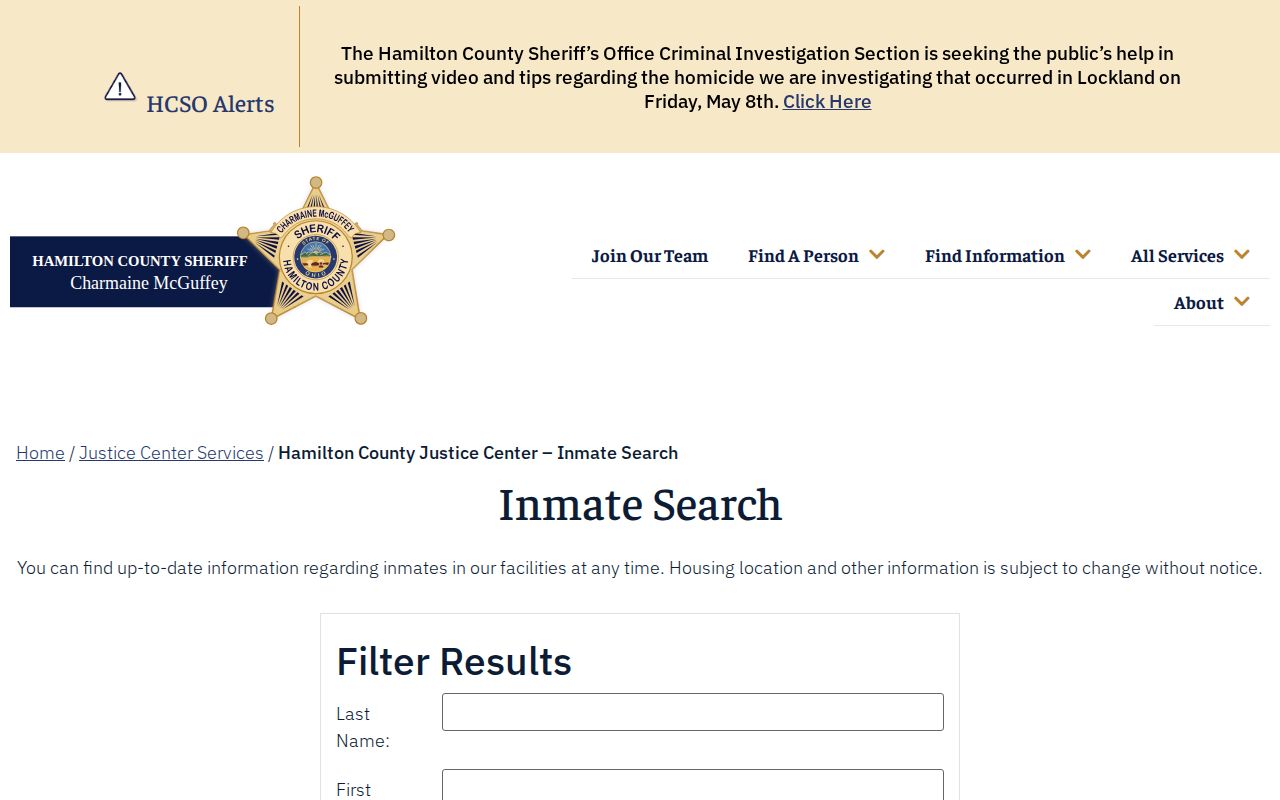
The image documents the current-custody interface. It does not reveal when a missing person stopped appearing or why the booking ended.
HCSO's records schedule lists paper and electronic inmate records as current year plus two additional years, with an “or until scanned” condition on the paper item. Archival retention can make a later request possible. It does not promise online visibility for that period. Nor does it disclose how quickly the current roster changes after release or transfer. Treat a negative search as weak evidence and move to the underlying record.
A current detail may display Projected Release Date, Holder, case numbers, court date, bond information, dispositions, and comments. Those are useful leads while a person is returned. Projected does not mean actual. One completed charge does not override another open case or holder. Save each identifier, then compare it with the final movement and court entries.
Classify Hamilton Release Results
A three-day record set becomes useful only when each line is read by custodian and destination. The phrase “released” can mean HCSO ended its booking even though another agency took custody. Use the release type exactly and confirm a named receiving agency in its own system.
| Recorded event | Verification path | Supported conclusion |
|---|---|---|
| Bond or recognizance | HCSO movement plus Clerk docket | The person left county custody on pretrial terms after all holds were resolved. |
| Time served or court order | Sentencing entry plus HCSO movement | The stated local custody component ended; other cases still must be checked. |
| Transfer to ODRC | ODRC admission and status | County custody ended while state incarceration began. |
| Federal or ICE transfer | Federal docket, BOP, or ODLS | HCSO release did not by itself establish community release. |
Ohio VINE can provide a general release or transfer event from the feeding agency. Preserve that event label. A general release is different from transfer, and a state “release from parole” means supervision ended rather than prison custody ended that day. The Ohio Attorney General instructs users not to rely solely on VINE, so corroborate the alert with HCSO or the receiving custodian.
If the local docket shows an Ohio prison sentence, search ODRC by name, committing county, and offender number. For federal matters, the Southern District docket may be needed because a USMS pretrial detainee may never appear as a sentenced BOP prisoner. ICE ODLS covers current detainees and those released by ICE during its recent public window. Each result concerns only that custodian.
When the record says bond, time served, or dismissal, review every Hamilton County case tied to the booking in the Clerk case-number search. A Municipal CRA or CRB complaint can lead to a Common Pleas B indictment, so closure of the first line may only mark a case transition. A Holder flag may also point to another jurisdiction. The Clerk record explains the legal event, while HCSO documents the physical movement. Neither source should be asked to prove facts that belong to the other.
Why Hamilton Releases Disappear
Hamilton County's name-only jail search is designed for current facility information, not historical movement research. It gives no official removal cadence and no time that a departed booking stays visible. Absence may follow community release, transfer, a spelling mismatch, delayed entry, or another change in the returned data.
That is why the three-day window must be built from records, not from repeated snapshots of the live roster. A sequence of blank searches still does not identify the release reason or destination. The existing movement record does. Pair it with the case docket for legal authority and with VINE or a receiving system for a second custody event. The full Hamilton County released-inmate record process is better suited to tracing one named person across all of those channels.