
ICE Custody Release Path
ICE custody is a federal civil immigration system, not a Hamilton County jail facility. Research found no official source proving a standing Hamilton County ICE detention contract or a universal local policy. A specific HCSO record may still show a destination or holder tied to ICE. When that happens, report only the documented event and avoid turning it into a county-wide rule.
The first event is departure from the Hamilton County Justice Center. The HCSO release or final-movement record should state the actual date and time, type, and destination or receiving agency. If it shows ICE pickup, the accurate phrase is “released from Hamilton County custody to ICE.” County criminal custody ended, while ICE custody began or continued.
The second event is any later release by ICE. That event belongs in ICE records and may appear temporarily in ODLS. A county court dismissal, bond, or time-served order can explain why HCSO custody was ready to end, but it does not prove what ICE later did. Keep the county order, county movement, immigration custody, and ICE release as separate steps.
Search ICE Release Records
Use the ICE Online Detainee Locator System, commonly called ODLS. One route requires the nine-digit A-number and country of birth. The other requires exact first and last name, country of birth, and date of birth. Exact spelling matters, and the A-number route is often stronger when that identifier is known.
- Choose the A-number or biographical search route.
- Enter the nine-digit A-number and country, or the exact name, country, and birth date.
- Review the returned ICE location or status carefully.
- Compare identity details with the HCSO holder or movement record.
- Record the access date because recent-release visibility is limited.
- Use the ICE ERO Services Line or records process when the public result is not enough.
ODLS covers people currently detained by ICE and people released from ICE custody within the preceding 60 days. That makes it a near-term locator, not a permanent archive. After the public window passes, a blank result has little historical value. Children under 18 are not searchable in the public interface.
A negative search can also reflect spelling, country, birth-date, or A-number problems. Try the supported identity route and confirm the number before drawing a conclusion. The broader Hamilton County release-record path can trace the HCSO episode before the ICE event.
ICE 60-Day Release Window
The ODLS release window is one of the most important limits. A result that reports recent release by ICE concerns the end of ICE custody, not the earlier HCSO handoff. Preserve the access date and exact status. After about 60 days, absence cannot establish that no immigration custody or release occurred.
| ODLS situation | Supported reading |
|---|---|
| Current detention result | ICE reports present civil detention in its system. |
| Recent release result | ICE reports release from ICE custody within its public window. |
| Blank result within the window | Uncertain; verify spelling, identifiers, and whether ICE was the custodian. |
| Blank result after the window | Weak historical evidence; use records procedures. |
| HCSO transfer record only | County custody ended to ICE, but later ICE release is not established. |
Save the HCSO booking number, holder text, release type, destination, A-number if lawfully available, and the ODLS access date. These identifiers allow a later records request to describe the event precisely. A screenshot can document what the public locator showed on that date, but the underlying agency record remains the stronger source for long-term verification.
Hamilton ICE Detainer Rules
An immigration detainer asks a local jail to notify ICE before an otherwise expected release and to maintain custody for up to 48 additional hours for pickup. ICE describes the detainer as a request. It is not an automatic deportation order, and its existence does not prove that ICE actually took custody.
The official ICE detainer explanation shown below describes the notification and transfer framework.
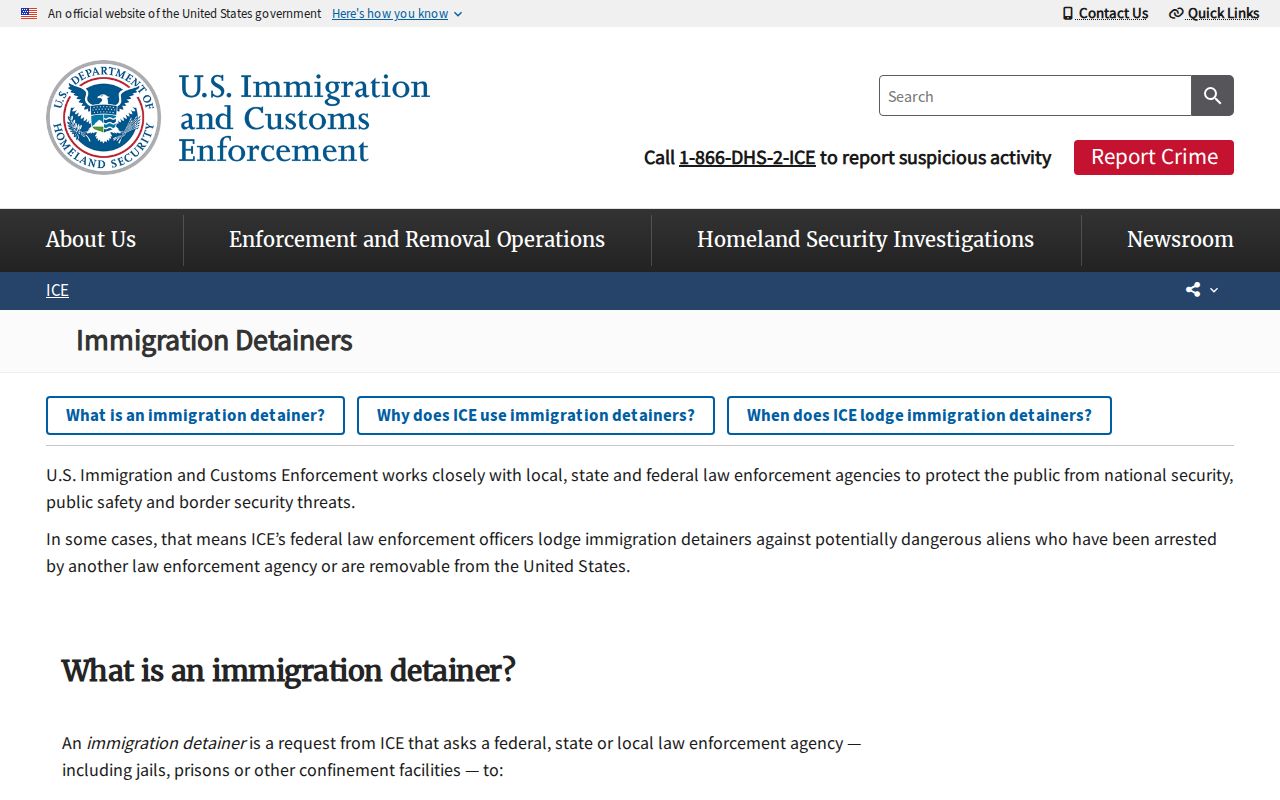
The source states that if ICE does not assume custody during the requested period, the local agency must release the person. The image therefore supports the detainer rule, not a claim that every Hamilton County case follows the same path.
A detainer also does not set the original criminal release time. HCSO first resolves the local court authority, jail processing, other cases, and holders. If ICE pickup occurs, the county movement record should document that transfer. Only a later ICE source can establish release from immigration custody.
ICE Custody Release Records
For the Hamilton County step, request the HCSO booking/release record and name the desired fields: actual date and time, release type, destination, and receiving agency. Include the inmate or booking number and booking date. A current HCSO result or its disappearance is not enough because the live search has no released archive.
For the immigration step, ODLS and the ICE ERO Services Line are near-term channels. Older release questions or a result outside the public window may require formal ICE records procedures. Keep the two requests distinct. HCSO documents its booking and handoff; ICE documents its detention and release.
Phone: 1-888-351-4024
Use for ICE detention-service questions and locator assistance.
A narrow request is easier to route. State the full name, A-number when known, birth information needed to distinguish identity, the approximate custody span, and the specific release or transfer record sought. Do not ask HCSO to certify the later ICE outcome, and do not ask the county Clerk for an immigration movement log.
The Hamilton County Clerk docket can still explain the local criminal authority. It may show bond, dismissal, time served, or another order that led to the county release point. The docket does not prove physical HCSO pickup by ICE, so pair it with the sheriff movement record.
Read ICE Release Evidence
Each source proves only its own stage. A Hamilton County docket can establish why local custody should end. HCSO can establish when its booking ended and where the person went. ICE can establish its own detention or recent release. Combining those facts is useful, but collapsing them into one “release date” is inaccurate.
| Evidence | What it proves |
|---|---|
| Hamilton County court order | Local criminal authority, not the final physical movement. |
| HCSO movement to ICE | County custody ended by transfer to immigration authorities. |
| ODLS current result | ICE reports current detention within its system. |
| ODLS recent release | ICE reports the later end of ICE custody within the public window. |
| Detainer alone | ICE requested notice and a temporary hold; pickup still must be confirmed. |
Do not infer deportation from a detainer or handoff. The research establishes only the request and custody transition. Immigration proceedings and outcomes require their own official records. Likewise, a person released from ICE may remain subject to immigration case requirements, but the public locator does not supply the complete case history.
If ODLS is blank, return to the identifiers and timeline. Verify the exact name, country of birth, date of birth, and nine-digit A-number. Check whether ICE actually received the person. If the claimed release is older than the public window, use the agency records route rather than treating absence as proof.
Confirm ICE Custody Departure
Start with the Hamilton County source. If the person was still shown by HCSO, record the booking number, Holder flag, and every case number. If the person disappeared, request the final movement rather than calling the absence an ICE transfer. The record must identify the destination.
Next search ODLS with the strongest available identifiers. A current ICE result confirms the second custody stage. A recent-release result confirms a later ICE departure within the locator's scope. Save the access date because the result will not remain a permanent public history.
Finally, express the conclusion at the level the two records support. “The person left Hamilton County custody for ICE” describes the first event. “ODLS later reported release from ICE custody within its recent window” describes the second. These sentences preserve the custodian, sequence, and evidence.
- Detainer
- A request for notice and a temporary hold so ICE may assume custody.
- Handoff
- The documented transfer from HCSO to ICE.
- ICE release
- The later end of ICE civil detention, distinct from county release.
- ODLS
- The public ICE locator with current and limited recent-release coverage.
When the public evidence does not resolve the sequence, state that confirmation was unavailable. Do not replace a missing official record with an assumption. The 60-day locator limit, exact-input requirements, and lack of a proven universal Hamilton County policy all make careful source language essential.
Timing can also create an apparent gap. The HCSO record may show the county handoff before ODLS reflects the ICE stage, or a recent ICE release may later vanish when the public period ends. Preserve both access dates and do not treat the gap as a third event. If the evidence is needed after the locator window, the saved identifiers and agency records request are more useful than a later blank screen.