
Hamilton County Release Meaning
A Hamilton County release closes one custody episode. It does not always mean the person went home. Someone may leave the Hamilton County Justice Center on bond, recognizance, a dismissal, time served, sentence expiration, or another court order. The same local booking may also end because HCSO transferred the person to the Ohio Department of Rehabilitation and Correction, another county, the U.S. Marshals Service, or ICE. Escape, death, and a record correction can also end normal roster display. Each event must retain its exact label.
The agency that last held the person supplies the movement record. The Hamilton County Clerk docket explains the legal authority, such as a bond change or sentencing journal, but it does not serve as the jail door log. Ohio VINE may report a general release or transfer from the agency feeding the system. If another custodian took control, that system becomes the next place to check. A state admission belongs to ODRC, a sentenced federal term belongs to BOP, and an immigration handoff belongs to ICE.
Hamilton County Release Types
The release type determines what should appear next. A bond or own-recognizance release is court-authorized pretrial release, so the case remains open. Time served means the court credited the custodial part as complete, yet a second case or holder can still keep the person confined. A dismissal resolves the stated charge only. By contrast, a prison commitment ends county jail custody through transfer and begins a state custody record.
| Recorded event | Meaning and next source |
|---|---|
| Bond or recognizance | Pretrial release after conditions, processing, and other holds clear; check the court order and HCSO movement. |
| Time served or sentence expiration | The local custodial term ended; check every case and the actual sheriff release time. |
| Dismissal or court order | The named charge or case changed; confirm no other case or holder controls custody. |
| ODRC transfer | County custody ended while state incarceration began; match the Hamilton docket to the ODRC admission. |
| Federal or ICE handoff | One custodian released the person to another; use the federal docket, BOP, USMS, or ICE source as applicable. |
Probation and parole are not release reasons that mean the same thing. Hamilton County probation, also called community control in many court records, is local court supervision. Ohio Adult Parole Authority supervision follows a state prison release through parole or post-release control. Discharge means a custodial term or supervision period has formally ended. These terms should be read from the source instead of inferred from a missing roster result.
Note: A holder is another agency or case claim that may prevent community departure after one charge has ended.
Hamilton County Release Record Fields
A useful Hamilton County release record answers who was held, which booking ended, when it ended, how it ended, and where responsibility went next. The public HCSO current inmate detail provides case context while a person is returned by the search. Its Projected Release Date, Holder flag, bond data, charge dispositions, and comments are not a final discharge certificate. A projected date may be unavailable, and a completed charge can coexist with another live case.
| Field | What it establishes |
|---|---|
| Name and inmate identifier | Connects the movement to the correct HCSO person. |
| Booking number and booking date | Identifies the exact custody episode rather than another arrest. |
| Actual release date and time | Records when that Hamilton County booking ended. |
| Release type or reason | Distinguishes bond, time served, court order, transfer, or another event. |
| Destination or receiving agency | Shows whether the person entered the community or remained in another custodian's control. |
| Case and holder references | Points to the court or agency records that explain the movement. |
HCSO's schedule lists paper and electronic inmate records for the current year plus two additional years, with a separate scanned-paper provision. That retention rule concerns agency files, not public web display. Arrest reports and electronic criminal jackets follow different schedules. For a state prison release, status, release or parole detail, supervision start, POA/PRD, and the APA office form the public trail, while ODRC Central Records is the route for exact documentary proof.
Note: Retention describes how long an agency keeps a record series, not how long a name stays visible online.
Request Hamilton County Release Records
The HCSO public-record request route is essential after a name vanishes from the current search. Ohio law does not require a requester to give a purpose or identify themselves, though the web form has required contact and incident fields. Ask for an existing booking sheet, booking photograph, and movement or release record. Include enough identifiers to isolate one custody episode. HCSO may charge actual copying and delivery costs, so request an estimate rather than assuming a fixed fee.
The strongest request is narrow and names the data sought: “actual date and time, release type, and destination or receiving agency.” That wording forces the key distinction between community departure and a ride-out to another institution. Do not ask for protected medical, victim, juvenile, or security-classification material.
- Collect the full booked name, inmate or booking number, booking date, and date of birth only if needed to distinguish the person.
- Request the booking record and final movement record for that custody episode, with the actual release time, type, and destination.
- Prefer an electronic copy and ask for a cost estimate before reproduction or delivery.
- If HCSO calls the request broad or unclear, ask how the release fields are organized and revise it under ORC 149.43.
- Match the response with the Clerk docket and any receiving custodian before stating what the release meant.
Jail Records can be reached at 513-946-6309. Ordinary inspection hours in the HCSO policy are 8 a.m. to 4 p.m. The Justice Center is at 1000 Sycamore Street, Cincinnati, OH 45202. The general line is 513-946-6400, and Jail Services is 513-946-6600. Court records follow the Clerk route instead of the sheriff form.
The successful capture of the official Hamilton County sheriff request page shows the correct fallback when a released person is no longer returned by the roster.
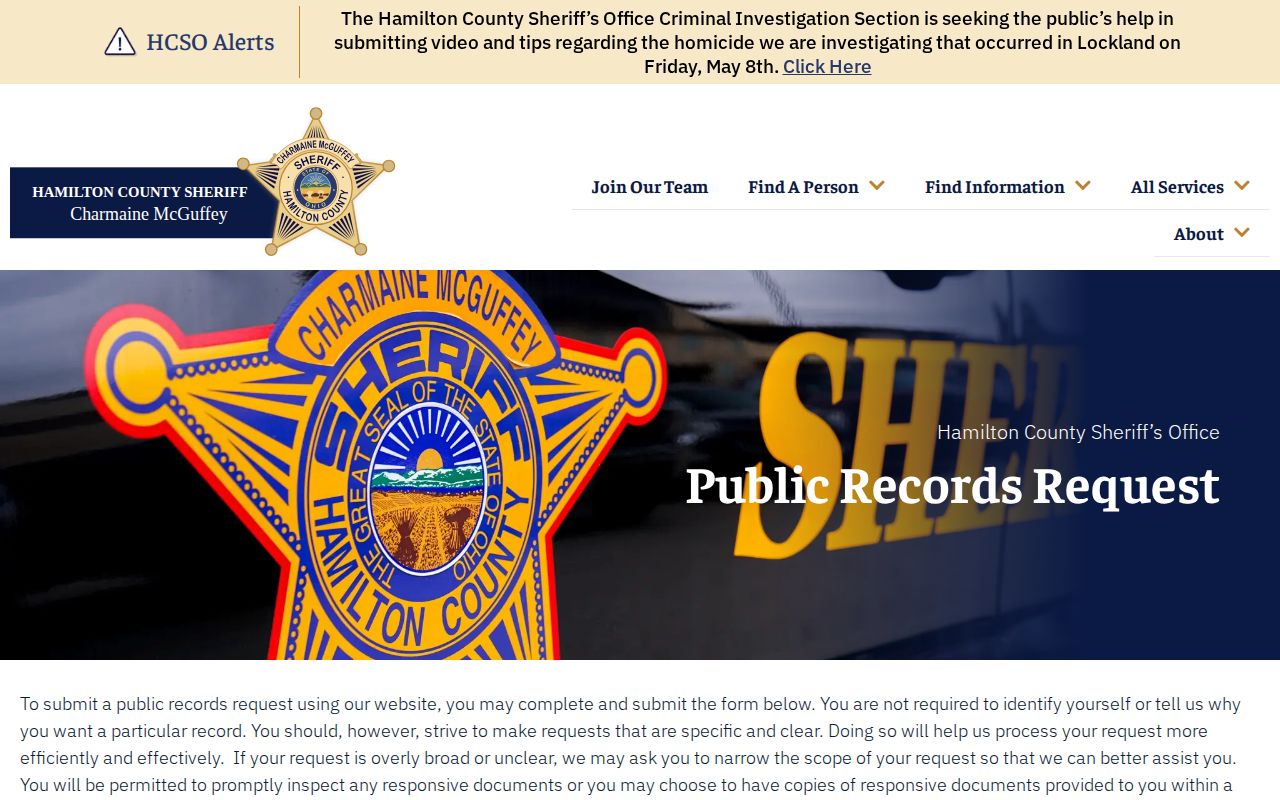
The page provides the request channel, while the requested release fields supply the proof the live search cannot preserve.
Hamilton County Bond Release Process
Hamilton County Pretrial Services works around the clock on jail intake, bail investigation and review, electronic monitoring, supervision, jail monitoring, and transition tasks. A judge's bond order authorizes a pretrial path. It does not record the time a person left the Justice Center. Release processing must finish, bond terms must be met, and every other case or holder must clear before community departure can occur.
For verification, read the bond order in Municipal or Common Pleas court, then get the HCSO movement record. A VINE general-release alert can corroborate the sheriff event. Electronic monitoring or Pretrial Services supervision remains a pretrial condition, not parole and not proof that a sentence was completed. If the HCSO detail showed Holder: Yes, the final movement record and receiving agency matter more than the bond line alone.
Hamilton County Release Property and Funds
Hamilton County uses distinct paths for personal property and account funds. Under the HCSO property procedure, a person in custody authorizes the release of clothing, a wallet, or keys through a kiosk. The person collecting those items must bring valid identification. The property office is in the Justice Center's south building, and its published number is 513-946-6330. Hours are Monday through Friday, 8 a.m. to 4 p.m., with holidays closed.
Money uses a separate social-services form. HCSO states that an account balance goes on a Release Pay debit card when the person enters the community. The agency expressly excludes a “ride out” to another institution from that card process. That local accounting rule offers a practical distinction: a ride-out ends the Hamilton County booking, but the person remains confined under the receiving institution. Property or funds handling should never be used alone to prove legal release.
Note: Property pickup and account payment are administrative steps; the final movement record remains the source for release type and destination.
Hamilton County Release Record Sealing
A blank court search can have a lawful cause. Hamilton County Municipal Local Rule 2 sets a local sealing process with a hearing at least 45 days after filing for a probation report. It lists a $50 application fee for a conviction and no fee for non-conviction sealing. Local Rule 9 says a fully sealed file may leave only an index or case-number notation. The Public Defender Fresh Start Clinic also provides local help with sealing information.
Sealing limits ordinary public visibility. It does not prove the arrest or custody episode never occurred, and it does not automatically erase each record kept by a separate agency under its own rules. Remote court access can also omit documents under Rule of Superintendence 45(C). When a public docket is missing, avoid reconstructing protected facts from scraps. Ask the lawful custodian whether a specific record is public, withheld, redacted, or sealed.
Ohio Revised Code 149.43 permits requests for qualifying records kept by public offices. Inspection must be prompt and copies provided within a reasonable period. An office can require enough clarity to locate existing records, but an office rejecting an ambiguous request must explain how records are organized and offer a chance to revise it.
Search Hamilton County Released Inmates
Start with the HCSO name search. A returned record means the person is shown in current Hamilton County custody. Save the inmate number, booking number, booking date, Holder flag, projected date, and every Municipal, Common Pleas, or other case number. If no result appears, do not declare release. Search every court case, check VINE's event label, and request the HCSO final movement.
The full path must follow the case beyond the jail when needed. A Hamilton felony sentence can create an ODRC admission. A federal holder may lead to a Southern District docket or USMS record before any BOP entry exists. An ICE handoff creates a separate civil custody event. A statutory registry applies only to qualifying registrants and cannot supply a universal release date.
- Search HCSO and preserve every local identifier if the current record remains visible.
- Search both Clerk divisions and follow each case through bond, sentence, dismissal, transfer, termination, or discharge entries.
- Check Ohio VINE for the person, source agency, and exact event, while treating the alert as corroboration.
- Request the HCSO booking and release movement when a person is absent or the destination is unclear.
- Continue in ODRC, the federal docket and BOP, or ICE ODLS when the record points to another custodian.
HCSO publishes no verified 24-hour or 72-hour released-person selector, feed, or jail-search app. Its official tool is name-only current custody. For a date range, request any existing daily report or movement entries between exact timestamps. If no compiled report exists, ask HCSO to identify the maintained record series and narrow the request.
Note: A negative online result is weak evidence because custody tools, notification systems, sealing rules, and archival windows differ.
Hamilton County Release Docket Crosswalk
Hamilton County case prefixes prevent a common search error. Municipal criminal complaints often use CRA or CRB. A felony complaint may later become a Common Pleas criminal case beginning with B. The phrase “INDICTED UNDER B” routes the reader to that felony docket. It is not a release disposition. A closed municipal line can reflect the move into the indicted case rather than community release.
Use the Clerk case-number search for each identifier on the HCSO detail. Read entries after the apparent disposition. Later bond changes, sentencing journals, jail-credit entries, capias orders, community-control changes, revocations, and discharge entries can alter the result. The docket supplies legal authority; HCSO supplies the actual movement time and destination.
When a needed entry is not remotely available, request the exact sentencing journal, bond-modification entry, dismissal, jail-credit order, or discharge by case number and filing date. The Clerk is at 1000 Main Street, Room 315, Cincinnati. Public counter hours are Monday through Friday, 8 a.m. to 4 p.m. Published copy rates are $0.10 per noncertified page and $1 per certified page, subject to confirmation before ordering.
Hamilton County ODRC Release Search
The ODRC Offender Search covers people in Ohio prisons, under ODRC supervision, or judicially released. It does not cover a county-jail-only stay. Search by name, then narrow to Released, APA Supervision, or Violators at Large. A known ODRC number gives a stronger match. Male numbers generally use A or R, female numbers use W, and six digits are entered without punctuation.
| Search field or result | How to read it |
|---|---|
| Last and first name | Starts a broad search; confirm identity through number, birth data, docket, and committing county. |
| ODRC number | Provides the most stable key for later searches and records requests. |
| Status | Read before institution: Incarcerated, Released, APA Supervision, or Violator At Large have different meanings. |
| Committing county and docket | Connect the state record to the Hamilton County judgment. |
| Expected Release Date/Parole Eligibility Date | A projected date or date pending parole consideration, not proof of physical release. |
| Supervision fields | Start date, period, public conditions, POA/PRD, and a Cincinnati APA office can support post-prison supervision. |
Read status before the institution line. APA SUPERVISION means ODRC reports release from incarceration under department supervision, even if the prison from the prior episode remains listed. Violator At Large means an APA supervisee is reported as having absconded, which means failing to remain compliant with supervision. It does not show a current location. Law enforcement must verify a warrant.
The official ODRC results interface captured for Hamilton County shows the Released, APA Supervision, and Violators at Large filters used to separate state statuses.
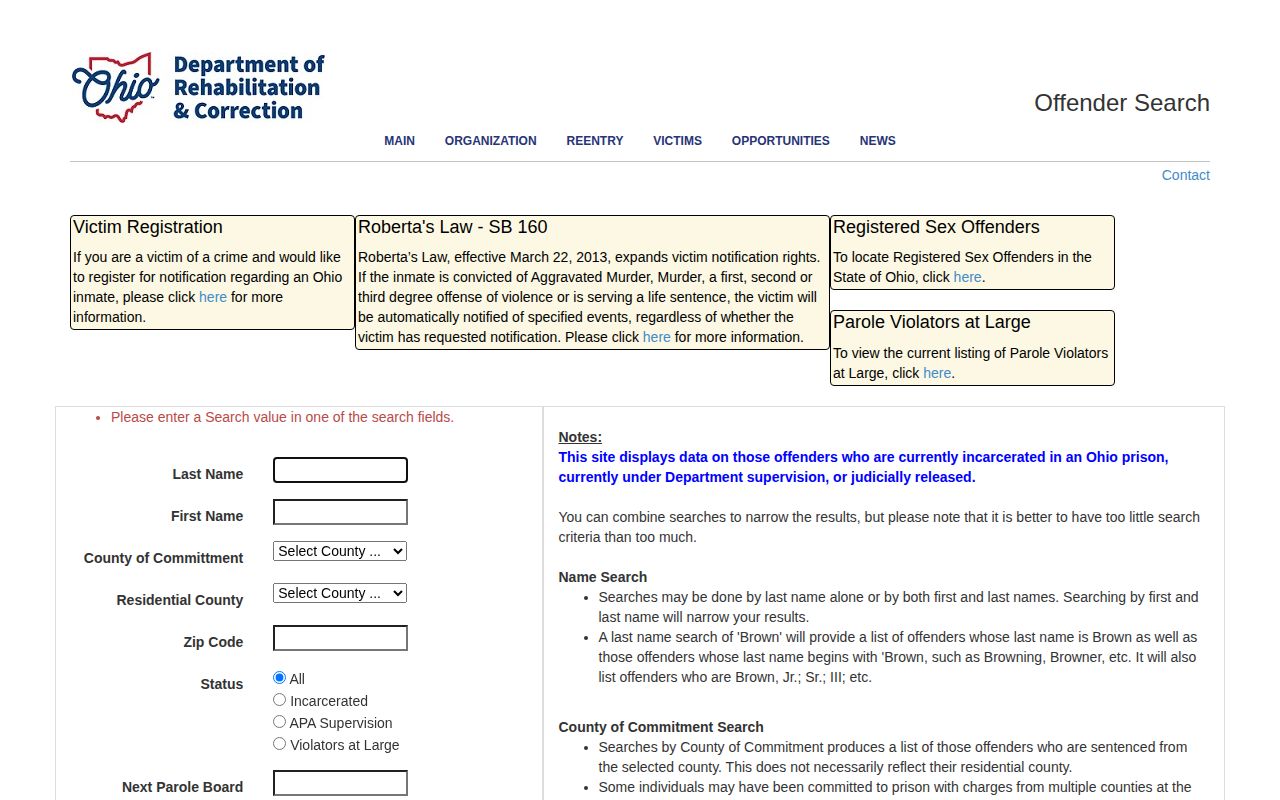
The filters help locate the state record, but release detail, supervision dates, and the sentencing docket must still be read together.
Hamilton County Release Verification Channels
VINELink checks one person and may report Hamilton County general release, transfer, escape, or death. Ohio state events add prison transfer, parole-hearing notices, revocation or return, release from parole, and other review events. “Release from parole” means supervision ended, not that prison custody ended that day. The Ohio Attorney General warns users not to rely only on VINE, since event feeds can lag.
Post-release supervision also splits by agency. ODRC's APA Supervision filter and numbered Cincinnati APA office fields verify state parole or post-release control. Hamilton County community control or probation is court supervision instead. The county probation guidance says those files are court property and are not public. Use the sentencing docket for the public order. Adult Probation is at 800 Broadway, Cincinnati; the felony officer line is 513-946-9844 and the misdemeanor line is 513-946-9600.
Federal cases need a separate route. The BOP Inmate Locator searches by federal number or name and refinements. A past release date with no location, RELEASED, or Not in BOP Custody establishes only that BOP custody ended. IN TRANSIT remains custody movement. A USMS pretrial detainee may never appear as a sentenced BOP prisoner, so use the Southern District docket, PACER, or the published USMS district line.
ICE ODLS searches by a nine-digit A-number and country of birth, or exact name, country, and date of birth. It includes current detention and people released from ICE custody during the preceding 60 days. A county handoff to ICE is not community release. ICE explains that a detainer requests notice and up to 48 extra hours for pickup. A later ODLS release is a second, distinct event.
- General release
- A VINE county event reporting departure from that source agency, subject to confirmation.
- Transfer
- Movement from one custodian to another while confinement continues.
- Parole
- Conditional release from state prison under APA supervision after the authorized process.
- Probation
- Hamilton County court supervision, separate from ODRC parole and post-release control.
- Discharge
- The formal end of the stated custody or supervision obligation.
Hamilton County Released Inmate Reentry
HCSO identifies a Re-Entry Unit that works with the county Commissioners' program. A local reentry resource directory places the Office of Reentry at 138 East Court Street, Room 101, Cincinnati, with weekday hours of 9 a.m. to 4 p.m. The office serves as a navigation point for identification and vital records, care, child-support matters, and sealing information after custody.
Reentry help is not a custody-status source. Use HCSO, the Clerk, ODRC, or the receiving system to verify the release first. Once the actual event is known, the reentry office can help a person address practical document and service needs. River City completion can also lead to postresidential court supervision, so a resident leaving that program should be checked through River City, the sentencing docket, and the supervising court department rather than the HCSO roster.
Note: Reentry services help after custody, while release verification remains the responsibility of the agency and court that created the records.
Hamilton County Release Payment Scam
Hamilton County court guidance warns about callers who use public arrest details and demand electronic payment for a claimed immediate GPS release. The county says it does not require an electronic-monitoring fee before a person is released from the Justice Center. A caller may know a real name or arrest detail and still provide false payment instructions.
Do not treat urgency, caller identification, or public case facts as proof. End the call and verify through a phone number published by the court or sheriff. Check the court docket for the actual bond or monitoring order, then confirm the final movement through HCSO. Never send funds through a caller's chosen payment method merely because the caller claims that release will be delayed.
Hamilton County Release Status Comparison
The same person can appear differently across systems because each source answers a narrower question. Current HCSO presence outweighs a completed disposition on one charge for the county custody question. An ODRC institution name can be historical when status says APA SUPERVISION. A BOP release does not resolve state, local, immigration, or court supervision. A blank search proves little without identifiers and records.
Still in Hamilton County custody: HCSO returns the current booking. Read all charges, cases, comments, Holder status, and the projected date without calling it an actual release.
Released from the Justice Center: HCSO's final movement gives the date, time, type, and destination. The Clerk explains the court authority, and VINE may corroborate the event.
Transferred to Ohio prison: HCSO custody ends, but ODRC admission and Incarcerated status show that confinement continued.
Released from Ohio prison: ODRC Released, judicial-release detail, or APA SUPERVISION and a supervision start support the state transition.
No longer in federal custody: BOP's past release date establishes the end of BOP custody only. Check the federal docket and any other holder.
Transferred to or released by ICE: The county handoff and later ICE release are separate events, and ODLS has a short recent-release window.
A person absent from every online source should be described as unconfirmed. Try alternate spellings and exact identifiers, search both local court divisions, account for sealing and remote-access limits, and request the specific sheriff or court record. If the record is lawfully sealed or exempt, public confirmation may remain unavailable.
Hamilton County Release Facility Paths
Hamilton County release research must follow the facility or system that held the person. The Justice Center is the main adult county jail. River City is a local residential community-corrections program, not an HCSO jail-search archive. Ohio prisons, federal placements, and ICE detention each have their own release sources.
- Hamilton County Justice Center: confirm community departure or transfer through HCSO movement records, the Clerk docket, and VINE.
- River City Correctional Center: confirm residential completion through River City, the sentencing docket, and the supervising court department.
- Ohio state correctional institutions: use ODRC Offender Search, release or supervision detail, Central Records, and the sentencing court.
- Federal custody: use the federal docket and BOP for sentenced custody, while recognizing that USMS pretrial custody may lack a BOP record.
- ICE custody: use ODLS for current or recent detention status and keep the county transfer separate from any later ICE release.
The correct conclusion should remain limited to its evidence: left Hamilton County custody on bond, transferred from HCSO to ODRC, left state prison under APA supervision, no longer in BOP custody, or released from ICE within its public window. “Free” is too broad when another custodian or supervision status may remain.